• Visit
  • What’s On
  • Learning & Research
  • About
  • SFU Art Collection

Closed

Wednesday–Sunday, 11AM–5PM

Closed for installation

Always Free

Support the Gibson

8888 University Drive

Burnaby, British Columbia

Canada V5A 1S6

778-782-4266

Closed

Wednesday–Sunday, 11AM–5PM

Closed for installation

Always Free

VisitGetting HereAccessibilityContactShop
Learning & ResearchUniversity Students & FacultyK–12 LearningKids & FamiliesTeen Art Lab
What's OnCurrentUpcomingArchive
AboutTeam & GovernanceSupportOpportunitiesFacility Rentals
SFU Art CollectionRecent AcquisitionsPublic Art

call

on view
Jun 4, 2026–Jul 3, 2026

Call for Applications

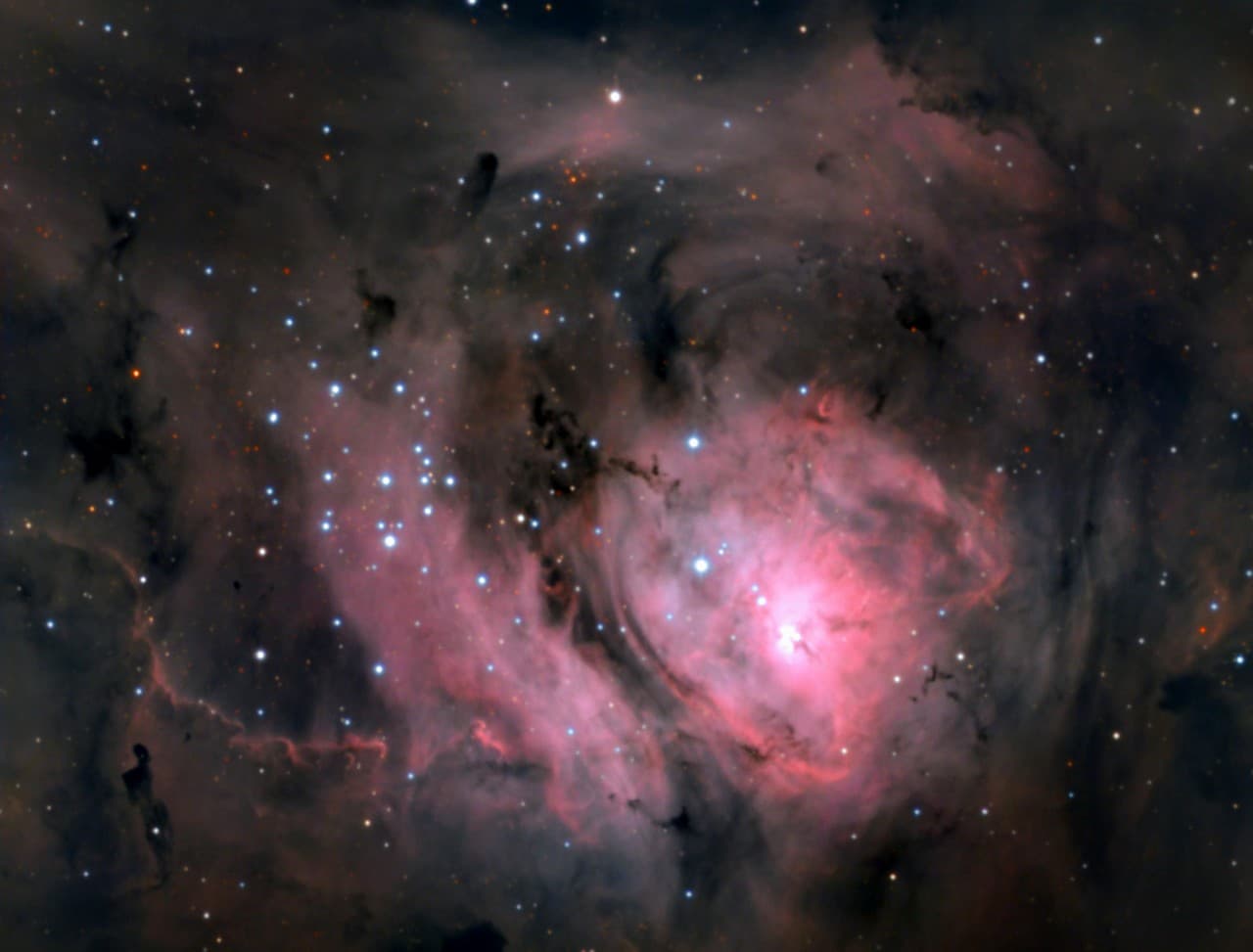
This the heart of the Lagoon Nebula, aka M8. This nebula is full of Bok globules, which are small dark nebulae made of a dense concentration of dust and gas from which stars may be born. Being 100 light years wide and about 5000 light years away, it's too big to fit in one shot from the Trottier Observatory. Perhaps we'll do a mosaic one day!

Trottier Observatory, Joanna Woo

Cosmic Commons Artist Residency

The Gibson is pleased to partner with the Institut français du Canada, as part of their “Résidences Ouest-Ouest” programme, and Simon Fraser University’s Department of Physics, to launch the Cosmic Commons Artist Residency on SFU’s Burnaby campus in Fall 2026. 

The Cosmic Commons invites applications to participate in a month-long, immersive residency experience for artists who have lived in France for at last five years, and who are interested in exploring the intersections between the arts and astrophysics and/or cosmology. Open to practices across the visual arts (including but not limited to sculpture, installation, film, video, digital arts, drawing, painting), performance; and sound, the residency seeks to build exchanges between artistic practice and astrophysics (studying the machinery of celestial bodies) and/or cosmology (studying the evolution of the universe as a whole), with particular research opportunities in particle physics phenomenology; the search for dark matter; galaxy evolution and stellar environments; and cosmic origins and acceleration. 

The Gibson Art Museum and Department of Physics will provide the selected artist with a space within the Gibson to work, as well as access to a studio and other spatial and AV resources as necessary. The artist will also be able to visit the Trottier Observatory and observe and take part in astrophysics seminar discussions. The artist will culminate their residency time with a series of public programmes, which could involve a lecture, performance, seminar, workshop, soundwalk or otherwise at the Gibson. Our aim is to create a supportive platform for new research at the crossroads of the arts and sciences. 

The residency will take place from November 2 to December 1, 2026, on SFU’s Burnaby campus. 

Contributors

  • Kimberly Phillips
  • Joanna Woo
  • Levon Pogosian
  • Gopolang Mohlabeng
Apply here

Partners

SFU Department of Physics
Institut Français
French Embassy


Kimberly Phillips is a committed arts leader, educator and writer of Welsh-Irish settler ancestry, based on the unceded territories of the xwməθkwəy̓ əm, Skwxwú7mesh and səl̓ílwətaʔɬ/Selilwitulh peoples. For the past 20 years, in her roles as gallery director, curator and teacher, she has worked to amplify the voices of under-acknowledged artists and practitioners, to ethically vision and build organizational capacity, and to create meaningful and unexpected ways for contemporary artists and their publics to find one another.

Since 2020 she has held the position of Director at SFU Galleries (and now the Marianne and Edward Gibson Art Museum). Previous to this she was Curator at the Contemporary Art Gallery (CAG) in Vancouver, where she oversaw the gallery’s exhibitions, publications and artist residencies. She served as Director / Curator of Access Gallery (2013 – 2017), a Vancouver artist-run centre committed to emergent and experimental practices, and as Curator of Interpretation at the Vancouver Art Gallery (2009 – 2013). Phillips holds a PhD in art history from the University of British Columbia (2007), where she was an Izaak Walton Killam Doctoral Fellow.

Phillips’s curatorial practice maintains a particular interest in the spectral and the resistant, as well as the conditions under which artists work. She has curated over 60 exhibitions and public art projects and has edited numerous books and catalogues. She looks for unlikely collaborations that create platforms for investigating the conditions of our contemporary world; while at Access Gallery, Phillips developed the internationally recognized residency and exhibition programme Twenty-Three Days at Sea, which saw artists travel across the Pacific Ocean aboard working container vessels. 

Phillips maintains an active teaching practice. She looks to steward opportunities for learners to inhabit the art museum as a place of open inquiry, develops curriculum and instructs courses at both graduate and undergraduate levels in visual culture and curatorial practice at Simon Fraser University and Emily Carr University of Art and Design, where she was awarded the Ian Wallace Award for Excellence in Teaching in 2015.

Joanna Woo is an Assistant Professor in the Department of Physics. An astrophysicist by training, her research focuses on galaxy evolution, including stellar populations, galaxy environments, and the use of advanced observational data, simulations, and machine‑learning techniques in astronomy. She earned her PhD in Astrophysics from the Hebrew University of Jerusalem and has held postdoctoral fellowships at ETH Zurich and the University of Victoria. Dr. Woo is also an award‑winning educator, having received SFU’s Excellence in Teaching Award (Early Career), and is actively involved in undergraduate teaching and astronomy outreach at SFU. https://www.sfu.ca/physics/people/faculty/jwa304.html

Levon Pogosian is a Professor of Physics and Chair of the Department of Physics and a leading theoretical cosmologist whose research uses cosmological observations to test fundamental physics. He received his PhD in Physics from Case Western Reserve University, following earlier degrees from Yerevan State University (BSc) and West Virginia University (MSc). After holding postdoctoral fellowships at Imperial College London, Tufts University, and Syracuse University, he joined SFU in 2006, where he co‑founded the university’s theoretical cosmology group. Professor Pogosian’s research focuses on cosmic acceleration, dark energy, modified gravity, the cosmic microwave background, large‑scale structure, primordial magnetic fields, and topological defects such as cosmic strings. His work is widely cited and has contributed to resolving key cosmological challenges, including the Hubble tension. In recognition of this work, he shared the 2021 Buchalter Cosmology Prize (First Prize) with Karsten Jedamzik. https://www.sfu.ca/physics/people/faculty/levon.html

Gopolang Mohlabeng is an Assistant Professor of Physics, specializing in theoretical particle and astroparticle physics. His research focuses on physics beyond the Standard Model, with particular emphasis on the particle nature of dark matter, neutrino–dark matter connections, particle cosmology, and terrestrial and astrophysical probes of new physics. Dr. Mohlabeng earned his PhD and MSc in Theoretical Particle Physics from the University of Kansas, and completed undergraduate studies in physics and astrophysics at the University of Pretoria and the University of Cape Town. Prior to joining SFU, he held research appointments as a Postdoctoral Research Associate at Brookhaven National Laboratory, a Postdoctoral Fellow at Queen’s University, and a Chancellor’s Advanced Postdoctoral Fellow at the University of California, Irvine. https://www.sfu.ca/physics/people/faculty/gmohlabe.html